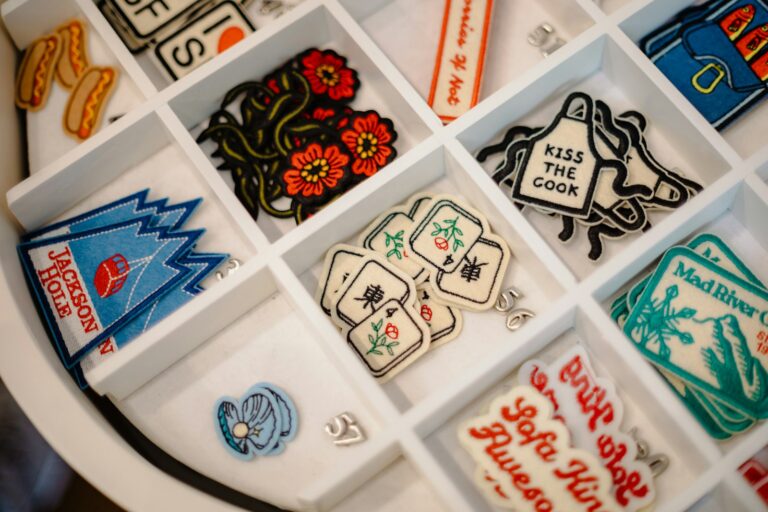


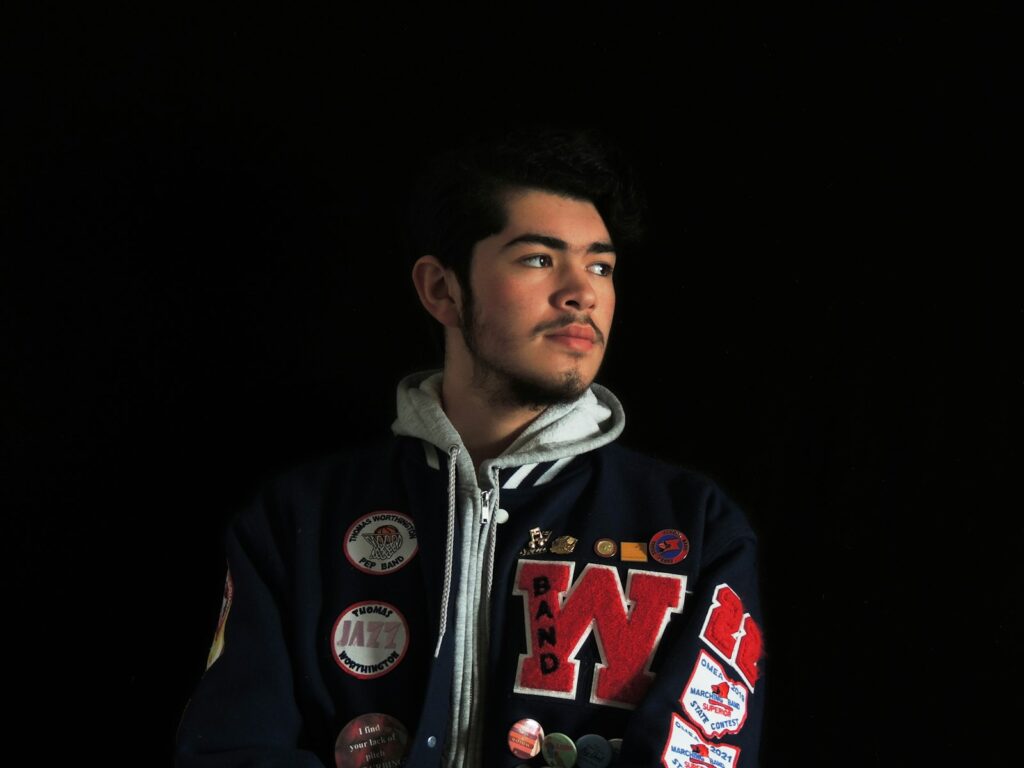
Chenille patches are the thick, fuzzy letters and emblems on varsity jackets. They have a soft, carpet-like surface that no other patch type has, and they are instantly associated with school sports, letterman jackets and vintage American style. In recent years fashion and streetwear brands have adopted them for hoodies, sweatshirts and caps as well.
This guide explains what chenille patches are, how they are made, what designs suit them and how to order and look after them.
What are chenille patches?
The word chenille is French for caterpillar, which describes the texture well. A chenille patch is made from yarn that is looped through a felt base to form a dense, raised pile. The surface is soft and deep, quite unlike the flat stitches of standard embroidery.
The felt base is usually visible around the edge as a border, and it is often layered: a second piece of felt in a contrasting colour sits behind the first to create a double outline. That layered felt edge is part of the classic varsity look. See examples on our chenille patches page.
How chenille patches are made
Chenille is produced on a specialised machine that makes two kinds of stitch.
- Moss stitch forms the loops of yarn that create the fuzzy filled areas.
- Chain stitch lays a flat, rope-like line used for outlines and for separating areas of colour.
The design is stitched onto felt, the patch is cut to shape, and any extra felt layers and the backing are added. When a design needs detail that yarn cannot provide, such as small text or a fine outline, standard embroidery is added on top or alongside. Many chenille patches are in fact a combination of chenille and embroidery.
Where chenille patches are used
- Varsity and letterman jackets: the large chest letter, sleeve numbers, graduation years and award patches.
- School sports and activities: letters and pins for athletics, band, academics and clubs.
- Team and club jackets: mascots and emblems for sports clubs and leagues.
- Streetwear and fashion: oversized letters and logos on hoodies, crewnecks, bomber jackets and caps.
- Retail merchandise: patches sold individually for customers to add to their own jackets.
- Cheer and dance teams: names and mascots on warm-up jackets and bags.
If you are ordering for a sports team, our guide to designing hockey team patches covers how chenille fits alongside the patches worn on game jerseys.
What designs suit chenille
Chenille is a bold material. The yarn is thick, so it fills large areas beautifully and cannot draw small detail.
Designs that work well:
- Single letters and initials.
- Numbers and years.
- Simple mascots with clear, solid shapes.
- Short words in block or script lettering at a large size.
- Logos made of a few large areas of colour.
Designs that do not work in chenille alone:
- Small text.
- Thin lines and fine outlines.
- Detailed illustrations.
- Gradients and shading.
- Logos with many small elements.
The usual solution for a more detailed logo is to use chenille for the large filled areas and embroidery for the lettering and outlines. That gives you the texture where it has impact and clarity where it is needed.
Size
Chenille needs room. Because of the thickness of the yarn, it is normally made at larger sizes than other patches, and it loses definition if it is made too small. A chest letter on a varsity jacket is a typical example of where it works best. For small placements such as a cap side or a cuff, a standard embroidered or woven patch is usually a better choice. Small chenille patches can be made when the design is very simple, such as a single letter or a basic shape.
Chenille vs embroidered patches
| Feature | Chenille | Embroidered |
|---|---|---|
| Surface | Soft, fuzzy, deep pile | Flat stitches, lightly raised |
| Base | Felt | Twill |
| Detail | Low | Medium |
| Typical size | Large | Any |
| Look | Varsity, vintage, bold | Traditional, versatile |
| Weight | Heavier | Lighter |
| Washing | Needs gentle care | Washes with the garment |
| Best for | Jackets, hoodies, statement pieces | Uniforms, caps, everyday apparel |
The two are often used together on the same garment: a chenille letter on the chest and custom embroidered patches for the name, the year or the sleeve badges.
Felt colours and layers
The felt is as much a part of the design as the yarn.
- Single felt gives one outline colour around the chenille.
- Double felt adds a second, wider layer in another colour behind the first, creating two outlines. This is the classic letterman style.
- Felt colour is usually chosen to contrast with the yarn and to match the garment trim. School colours are the usual starting point.
A simple rule works well: yarn in the main colour, first felt layer in the second colour, and the second felt layer back in the main colour or in white.
Edges
Chenille patches are cut to shape, with the felt forming the edge. They do not normally have the wrapped merrowed border found on traditional embroidered patches. If you are comparing edge styles across patch types, our guide to merrowed vs laser-cut borders explains the options.
Backing options
- Sew-on is the standard for chenille. The patches are thick and fairly heavy, and stitching through the felt edge holds them securely on a jacket.
- Heat seal or iron-on backing is available and is useful for holding the patch in position. Because chenille is heavy and the yarn should not be crushed by heat, stitching the edge as well is strongly recommended.
- Adhesive backing suits temporary placement only.
Press from the back of the garment when applying heat, so the pile is not flattened. Our guide to the types of patch backings has full attachment steps.
Caring for chenille patches
Chenille needs gentler treatment than other patches, because the yarn pile can mat and the felt can lose its shape.
- Turn the garment inside out before washing.
- Wash cold on a gentle cycle, or hand wash. Dry cleaning is the safest option for wool varsity jackets.
- Do not use bleach.
- Do not tumble dry. Lay flat or hang to dry.
- Do not iron directly onto the chenille.
- If the pile flattens, brush it gently with a soft brush once it is dry.
What affects the price
Chenille is priced on the same principles as other patches: size, quantity, the number of yarn colours, felt layers and any added embroidery. Because chenille patches are usually large, size is the main driver. Our guide to custom patch cost factors explains how each factor works.
Ordering chenille patches
To quote accurately we need:
- Your artwork or the letters and numbers you want.
- Width and height.
- Yarn colours and felt colours.
- Single or double felt.
- Backing.
- Quantity.
Standard turnaround is 20 to 30 days and express is 10 to 14 days. If you are ordering for a school year or a season, count back from the date the jackets are needed and allow time for sewing. When you are ready, request a chenille patch quote.
Frequently asked questions
What are chenille patches made of?
Yarn looped through a felt base to form a soft, raised pile, often combined with embroidery for detail.
Can chenille patches be ironed on?
They can be made with a heat-activated backing, but because they are heavy they should also be stitched around the edge.
Can chenille patches be washed?
Yes, gently. Wash cold and inside out, and do not tumble dry. Dry cleaning is safest for wool jackets.
How small can a chenille patch be?
Chenille works best at larger sizes. Small patches are possible only for very simple designs such as a single letter.
Can I have small text on a chenille patch?
Not in chenille itself. Small text is added in standard embroidery.