
A department patch does a job that most patches do not. It has to be recognisable at distance, survive conditions that would destroy an ordinary patch, stay identical across reorders that may be years apart, and carry a design that often has decades of history attached to it.
That combination makes emergency services patches one of the more demanding things we produce. This covers the design conventions, the material decisions that actually matter, and the parts of the ordering process that catch departments out.
[IMAGE PROMPT: Three finished shoulder patches arranged on a dark wooden surface — a fire department patch, a police shoulder patch and an EMS patch — shot from above with even, slightly dramatic lighting. Generic designs, no identifiable real department names visible.]
The design conventions
Emergency services patch design is more codified than most people realise. Departure from the conventions is possible, but it should be deliberate.
Fire departments commonly build around the Maltese cross, the traditional symbol of firefighting service. Designs typically carry the department name on an upper arc, the city or county below, and often the year of founding. Local landmarks appear frequently — a bridge, a mountain, a county outline. Red, gold and black dominate.
Police and sheriff’s departments tend toward shield and star shapes. Seven-pointed and five-pointed stars both appear, and the point count sometimes carries local significance. State outlines and state seals are common elements. Navy, gold and silver are the usual palette.
EMS services use the Star of Life — a six-pointed blue star with the Rod of Asclepius at its centre. It is the standard identifier for emergency medical services and is widely expected on EMS insignia. Blue and white with white or silver detail is the norm.
Common to all three: unit number, rank designation, years of service rockers, and specialist qualifications like hazmat, technical rescue, K9, dive team or paramedic. These are usually smaller companion patches rather than elements crammed into the main design.
One recurring design problem is the arc text. Department names run around a curved upper edge, and long names at small sizes are where legibility fails. If the department name is long, the answer is a wider patch, not smaller text.
Size and placement
Shoulder patches for emergency services typically run 4 to 5 inches tall, worn on one or both sleeves. The height is driven by readability at distance — someone identifying a unit across a scene needs to read it, not squint at it.
| Item | Typical size |
|---|---|
| Shoulder patch | 4 – 5 inches tall |
| Name tape | 1 x 4 inches |
| Chest / badge-style patch | 3 – 4 inches |
| Cap patch | 2 – 2.25 inches tall |
| Back panel (turnout or duty jacket) | 8 – 12 inches wide |
| Rank insignia | 1 – 2 inches |
If you are ordering a full set, build three versions of the design rather than scaling one file. The shoulder patch carries everything. The chest patch drops the founding year and secondary text. The cap patch keeps the central symbol only. There is more on this in our custom patch size guide.
Durability: the part that actually differs
An ordinary embroidered patch is polyester thread on a twill backing. For most uses that is entirely fine. For emergency services it depends heavily on which garment it is going on.
Duty uniforms, polos and job shirts. Standard embroidered patches are appropriate. The main requirement is wash durability — these garments get laundered constantly, often on hot cycles. Quality thread and a properly finished border are what determine whether the patch still looks right after two years.
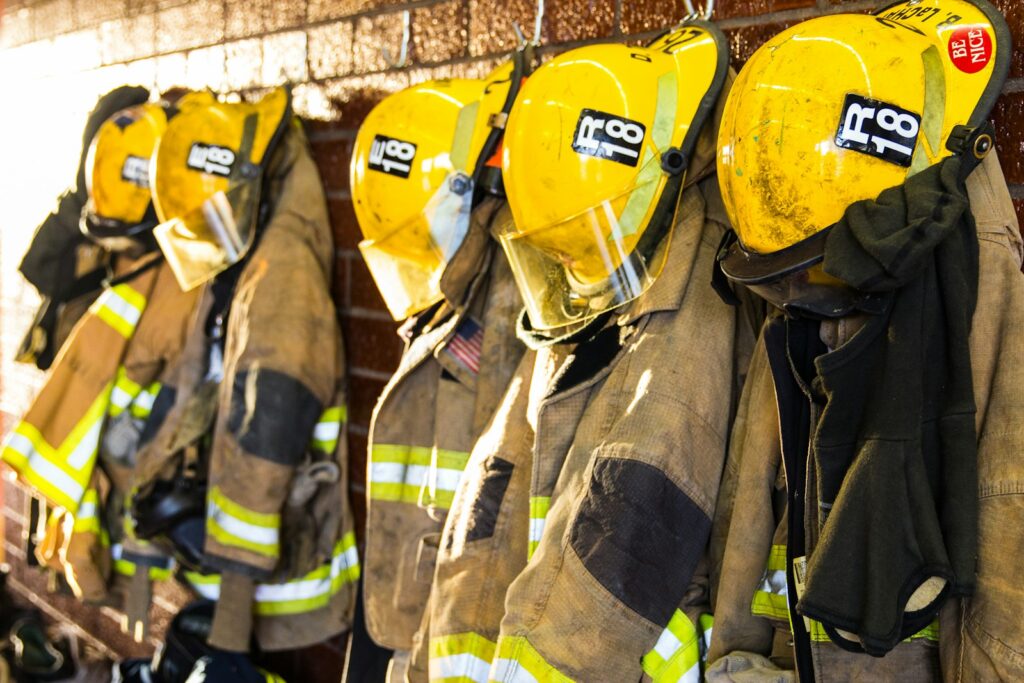
Turnout gear and structural firefighting PPE. This is a different situation entirely. Turnout gear is built from flame-resistant aramid materials, and anything attached to it should not undermine that. Standard polyester thread melts. Patches intended for turnout gear are made from aramid materials — Nomex and similar — rather than polyester, specifically so they do not become a failure point in a heat exposure.
This matters enough to state plainly: if the patch is going on structural firefighting PPE, say so when you request the quote. Your department’s PPE policy and the gear manufacturer’s requirements govern what can be attached and how, and applying a non-compliant patch can affect the certification of the garment. We will quote the appropriate material, but the compliance decision sits with your department.
High-visibility and night operations. Reflective materials and reflective thread give the patch retroreflective return under headlights and scene lighting. This is standard on many EMS and roadside-operations garments. Reflective elements can be integrated into an otherwise conventional embroidered patch — usually as an outline, the lettering, or a border.
[IMAGE PROMPT: A patch with reflective elements photographed twice in a split-frame composition — left side under normal lighting, right side with a direct light source showing the reflective thread returning bright white. Dark background.]
Material options in practice
Embroidered is the default and the traditional choice. It looks the part, it is what departments expect, and the texture reads as official in a way flatter formats do not. Full specs on our custom embroidered patches page.
Woven holds fine detail better than embroidery. If your department seal has small text, thin linework or a detailed illustration that embroidery would have to simplify, woven patches preserve more of it. The trade-off is a flatter, less traditional appearance.
PVC is weatherproof, wipes clean and will not fray. It suits equipment bags, outer shells and gear that lives outdoors. It reads as modern rather than traditional, which some departments want and others specifically do not.
Bullion — metallic wire embroidery — is used for ceremonial and dress uniforms, honour guard and command staff. It is hand-intensive and priced accordingly, but nothing else looks like it.
Most departments end up with a mix: embroidered for duty uniforms, something more durable for outer gear, and bullion for dress occasions. Where rank or certification changes regularly, hook and loop backing lets one garment carry several designations.
Ordering for a department? Send us your existing patch or artwork and tell us what garments it is going on. We will confirm the right material and turn a quote around. Request a quote →
Colour consistency across reorders
This is the issue that generates the most frustration, and it is preventable.
Departments do not order once. They order now, and again in three years when the roster grows, and again after a uniform change. If the second batch is a slightly different shade of blue from the first, you have a visible inconsistency across the department.
The fix is to lock the colours to specific thread codes at the first order. Ask for the thread numbers used on your run and keep them on file with your procurement records. Pantone references are useful as a starting point, but the thread code is the thing that actually reproduces — our free thread colour converter shows how a given colour maps across the major thread brands.
Keep a physical sample from every production run as well. A reference patch in the procurement file settles any question about whether a new batch matches.
Authorisation and artwork
Department insignia is generally controlled. Reproducing official patches without authorisation is a real problem — counterfeit law enforcement insignia is regulated in most jurisdictions, and legitimate manufacturers ask questions before producing it.
Expect to confirm that you are authorised to order on behalf of the department. For official department insignia we ask for confirmation of affiliation. This is standard practice across the industry and it protects your department as much as it protects us.
On artwork: many department designs are old. The file that exists is often a scan of a scan, or a photograph of a patch from the 1980s. That is workable — a design can be redrawn and digitized from a good photograph of an existing patch — but it takes longer than a clean vector file, and the redraw needs sign-off from someone in the department before production. Build that approval step into your timeline.
Timeline and ordering
Standard production runs 20 to 30 days. Express production is 10 to 14 days. Departments working to a uniform rollout date, an academy graduation or an anniversary should work backwards from the date and add time for the approval step — the design sign-off is usually what delays these orders, not production.
A realistic sequence:
- Send artwork and specs, get a quote.
- Digitizing and a digital proof for approval.
- Physical sample if the order is large or the design is new.
- Sign-off.
- Production.
[IMAGE PROMPT: An embroidery machine mid-production with multiple heads running the same patch design simultaneously, thread cones visible above. Slight motion blur on the moving frame to convey the machine running.]
Steps 2 and 3 are where department orders sit longest, because they need a committee or a chief to approve them. Plan for that rather than being surprised by it.
Emergency services patches are worth getting right because they last. A department patch designed and produced properly will still be on uniforms in fifteen years. Start from the types of custom patches overview if you are still deciding on a format, or send your specs through the custom patch quotation form if you are ready to price it.