
Velcro backing turns a patch from a permanent decoration into something you can swap in seconds. That is why it dominates tactical gear, security uniforms and morale patch culture, and why it keeps spreading into workwear, sports bags and streetwear.
It also causes more ordering confusion than any other backing type, because two different things get called “velcro” and ordering the wrong one leaves you with a box of patches that will not stick to anything. Here is how it actually works.
[IMAGE PROMPT: Close-up of a hand pressing a rectangular morale patch onto the loop panel of a tactical plate carrier, mid-motion so the patch is slightly lifted at one corner. Shot from a low side angle, natural light.]
Hook and loop: the part everyone gets wrong
“Velcro” is a brand name. The generic term is hook and loop, and it describes a two-part system:
- Hook is the rough, scratchy side. It is covered in tiny stiff hooks.
- Loop is the soft, fuzzy side. It is a field of small loops that the hooks grab.
Neither side sticks to itself. You need one of each for the system to work.
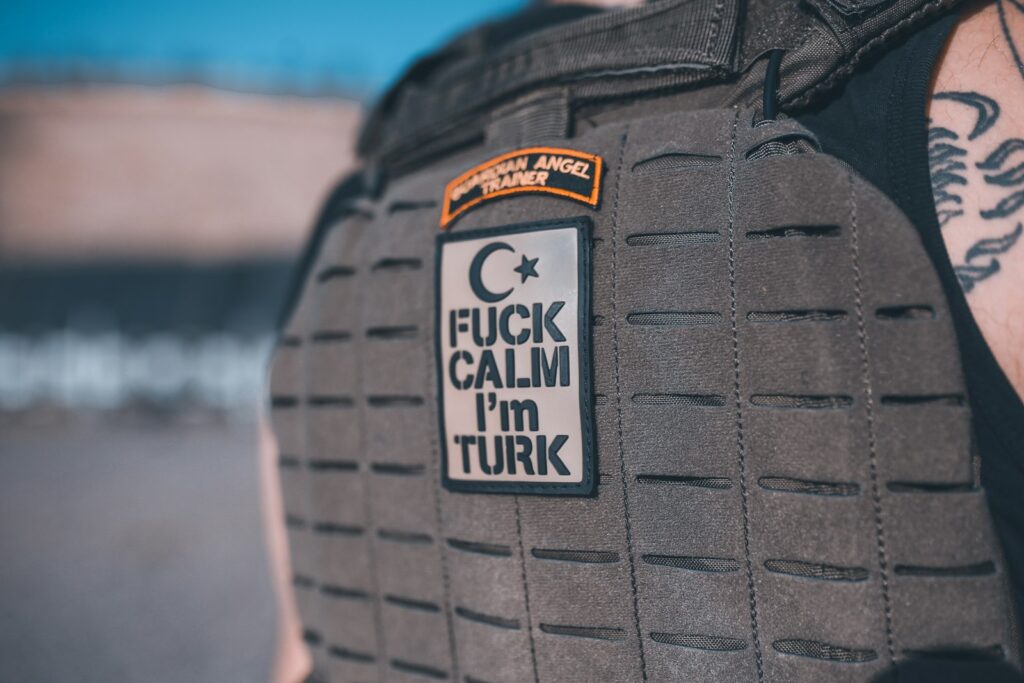
The standard convention is that the patch gets the hook side and the garment gets the loop side. This is not arbitrary. Loop panels are softer against the body, and a garment covered in exposed hook would snag on everything it touched in the wash.
So when you order, the default is hook backing on the patch. If your gear already has loop panels sewn onto it — most plate carriers, tactical caps, range bags and many work jackets do — hook backing is all you need.
When you need a two-piece set
If your garment does not already have a loop panel, you need both halves. That is a two-piece set:
- Hook sewn or fused to the back of the patch.
- A matching loop piece supplied separately, cut to the same shape, usually with an adhesive backing or sew-on edge.
The loop piece goes on the garment first — stitched down is the durable option, adhesive is the quick one — and then the patch attaches to it. Adhesive-backed loop is fine for bags and hard-wearing outerwear, but on anything that gets washed regularly, stitch it. Adhesive gives up faster than people expect once heat and detergent get involved.
Worth knowing: two-piece sets cost more per unit than hook-only, because you are producing and cutting a second component. If half your order is going onto gear that already has loop panels, tell us the split rather than ordering two-piece for everything.
Full-back vs border velcro
There are two ways to attach the hook to the patch.
Full-back velcro covers the entire reverse of the patch. It gives the strongest hold, keeps the patch flat, and is the standard for anything that needs to survive movement — plate carriers, duty vests, packs.
Border or partial velcro attaches hook only around the edge or in a central strip. It uses less material and keeps the patch a little more flexible, but it allows corners to lift. It is generally not worth the small saving.
For patches above roughly 4 inches, full-back is effectively mandatory. A large patch on border velcro will peel at the edges the first time it catches on something.
Which patch materials work with velcro
Almost any patch type can take hook backing, but they do not all behave the same way once it is on.
Embroidered patches are the most common pairing. The stitched surface and the twill base give the hook something solid to be sewn or fused to, and the result sits flat. This is the default choice for most uniform and morale applications — see custom embroidered patches for the material specs.
PVC patches take velcro exceptionally well. The rubber body is already stiff and weatherproof, so the patch holds its shape without any support from the garment underneath. PVC with hook backing is the standard combination for outdoor and tactical gear, covered in more detail on our custom PVC patches page.
Woven patches work, but they are thin and flexible. With full-back velcro they are fine. With border velcro, a woven patch tends to bow in the middle.
Leather patches with velcro are heavy. On a bag or a jacket panel this is not an issue. On lightweight gear, the weight works against the hold.
[IMAGE PROMPT: Overhead shot of three patches face-down on a workbench showing their backs — one embroidered with full-back black hook, one PVC with full-back hook, one with a separate adhesive loop square sitting beside it. Industrial workbench surface, slightly worn.]
Thickness is the trade-off
Velcro adds bulk. A hook layer plus a loop layer sits roughly 2 to 3mm off the garment before you even count the patch itself. That has three consequences worth planning around:
- The patch sits proud of the surface. It is more likely to catch on straps, seatbelts and door frames.
- It changes the look. A velcro patch never sits as flush as a sewn or iron-on patch. If the aesthetic matters — a branded polo, a retail garment — sewn is the cleaner option.
- It affects layering. A velcro patch under a jacket creates a visible bump.
If the patch does not actually need to come off, do not use velcro. Interchangeability is the entire benefit, and you pay for it in thickness and cost. Our comparison of patch backing types covers the sewn, iron-on, adhesive, magnetic and pin alternatives side by side.
Need velcro patches for a uniform program or a gear run? Tell us your quantity, sizes and whether your gear already has loop panels, and we will price it properly. Request a quote →
Who actually uses velcro patches
Military and tactical. Morale patches, unit identifiers, blood type and callsign panels. The ability to strip identifying patches off gear quickly is a functional requirement, not a convenience.
Security and event staff. One vest, multiple roles. Swap the patch, change the designation. It removes the need to stock separate garments for every role.
Fire, police and EMS. Rank and certification levels change, and the garment should not have to. There is more on department insignia in our guide to patches for fire, police and EMS departments.
Work uniforms with name patches. Shared garments in a rotating crew only work if the name comes off. Standard name tape size is 1 x 4 inches, and velcro is what makes a shared pool of jackets practical.
Airsoft, paintball and shooting sports. Team identification that changes between events.
Streetwear and brand merchandise. Increasingly, brands ship a garment with a loop panel and sell patches separately as an add-on. It is a genuinely good model — the customer buys once and keeps buying patches.
Washing and care
This is where velcro patches get ruined, and it is entirely preventable.
Remove the patch before washing. This is the correct answer and the simplest one. Take the patch off, wash the garment, put it back.
If you cannot remove it, close the hook against a loop surface first. Exposed hook in a washing machine will grab every fabric in the drum, pull threads out of knitwear, and come out clogged with lint. Clogged hook loses grip permanently — the lint packs into the hooks and they stop closing properly.
Do not tumble dry velcro patches on high heat. Heat softens the hook and the fused backing. Low heat or air dry.
Clean clogged hook with a stiff brush or a fine-tooth comb, working against the direction of the hooks. It restores most of the grip if you catch it early.
Ordering checklist
Before you send the request, have these ready:
- Artwork, in vector format if you have it. If not, the highest-resolution file you can find works.
- Dimensions, width and height in inches — our custom patch size guide covers the standard sizes for each placement.
- Hook only or two-piece? Check whether your gear already has loop panels.
- Quantity, including whether you expect to reorder.
- Patch material — embroidered, PVC or woven. If you are unsure, describe the environment it will live in and we will recommend one.
[IMAGE PROMPT: A row of six different morale patches laid out on a tactical loop panel, each a different design and material — embroidered, PVC, woven — demonstrating variety on a single mounting surface. Straight overhead, hard directional light casting slight shadows.]
Velcro is the right backing whenever the patch needs to change more often than the garment does. When it does not, one of the other options will look better and cost less. Our overview of the types of custom patches covers which material suits which job.