
The first thing most buyers ask is what custom patches cost. The honest answer is that it depends, which is not much help unless you know what it depends on. Two patches that look similar can be priced quite differently because of choices that are not obvious from a picture.
We quote every order individually and do not publish a price list, so this guide does not give figures. What it does is explain the nine things that move the price up or down, so you can make those choices on purpose and get an accurate quote the first time.
1. Size
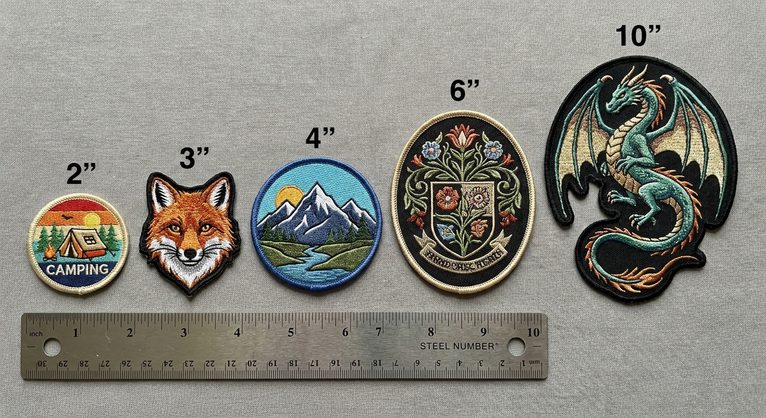
Size is the biggest single factor after quantity. A larger patch uses more material and takes more machine time. Patch size is measured as the average of the width and the height, so a 4 inch by 2 inch patch is quoted as a 3 inch patch. Our custom patch size guide explains the measurement and the sizes that suit each placement.
Small changes matter here. Going up by half an inch can move a patch into the next price bracket, so it is worth choosing the smallest size at which your design is still clear.
2. Quantity
Every custom order has setup work: preparing the artwork for production, setting up the machine and running the first pieces. That cost is the same whether you order a few dozen or a few thousand, so it is spread across however many patches you buy. The price per patch falls as quantity rises, and the drop is steepest at the lower end.
The practical lesson is to think ahead. If you will need more of the same patch within a year, one larger order is usually better value than two small ones.
3. Patch type
Each type is made differently, and that changes the cost structure.
- Embroidered patches are priced largely on stitch count, which comes from size and thread coverage.
- Woven patches are made in a single weaving process, so fine detail adds less to the cost than it does in embroidery. Our comparison of embroidered vs woven patches covers when each one makes sense.
- PVC patches are made in a custom mould, which is a setup cost that thread patches do not have. It is spread across the order, so it matters most on small quantities. See custom PVC patches.
- Chenille patches use thick yarn on a felt base and are usually made at larger sizes. See chenille patches.
- Leather and sublimated patches are priced on their own materials and processes.
4. Embroidery coverage
On an embroidered patch, coverage is the share of the surface that is covered by thread. At lower coverage the twill base shows through as the background. At full coverage the whole patch is stitched. More coverage means more stitches, more thread and more machine time, so it costs more. If your design has a plain background colour, letting the twill provide that colour is one of the simplest ways to reduce the price without changing the design.
5. Number of colours
Each thread colour is a separate element the machine has to run. A design with a handful of colours is quicker to produce than one with many. With PVC the effect is stronger, because each colour is filled into the mould separately. Reducing a logo from a long list of close shades to a few distinct colours often improves how it looks as a patch as well as what it costs.
6. Backing
A plain sew-on patch has no backing material added. Iron-on, velcro, adhesive, pin and heat seal backings each add material and a production step. Velcro generally adds the most because it has two parts. Choose the backing for how the patch will be used, not for price alone. Our guide to the types of patch backings explains which one suits which job.
7. Shape and border
Simple shapes such as circles, squares, rectangles and shields can be finished with a merrowed border, which is the traditional wrapped edge. Custom shapes that follow the outline of the artwork are cut to shape and finished with a stitched edge. Very intricate outlines with many points and narrow sections take more care to produce.
8. Special threads and effects
Standard thread is the baseline. Metallic thread, glow-in-the-dark thread, reflective material and raised 3D embroidery are all extras that add cost. They can be worth it when used on a small part of the design for emphasis. Used across the whole patch they add up quickly.
9. Turnaround time
Our standard turnaround is 20 to 30 days, and express is 10 to 14 days. Express production is priced higher because your order is moved ahead in the schedule. The cheapest way to buy patches is to order early. Work back from the date you need them and allow time for approving the proof and for attaching the patches once they arrive.
How to bring the cost down
- Order the smallest size at which the design is still readable.
- Combine expected reorders into one larger order.
- Let the base fabric show as the background instead of stitching it.
- Cut the number of colours to the ones that matter.
- Choose a standard shape if your design allows it.
- Use special threads sparingly.
- Order early enough to use standard turnaround.
- Choose sew-on backing if the patches will be stitched on anyway.
None of these reduce quality. They remove cost that was not adding anything to the result.
What does not save money
Some choices look like savings and are not. Shrinking a patch until the text is unreadable gives you a cheaper patch nobody can read. Choosing adhesive backing for uniforms means replacing patches after the first wash. Ordering the bare minimum and then reordering a month later costs more than ordering enough the first time. The cheapest patch is the one you only have to buy once.
What to send for an accurate quote
A quote is only as accurate as the details behind it. To avoid a revised price later, include:
- Your artwork, in the best quality file you have.
- Width and height in inches.
- Quantity, and whether you expect to reorder.
- Patch type, or what the patch is for if you are unsure.
- Backing.
- The date you need the patches by.
With those six details we can price the order properly. Request a quote here, or compare the patch types first on our custom patches page.
Frequently asked questions
Why do you not publish prices?
Because price depends on size, quantity, type, coverage, colours, backing and turnaround. A single published price would be wrong for most orders, so we quote each one.
Does a bigger order always cost less per patch?
Yes. Setup costs are spread across more pieces, so the price per patch falls as quantity rises.
What is the cheapest type of patch?
It depends on the design. A simple embroidered patch with low coverage and few colours is economical. For very detailed artwork, woven can be better value than trying to embroider the same detail.
Does the number of colours really matter?
It does, particularly for PVC, where each colour is added separately. For embroidery the effect is smaller but still real.
Is express production worth paying for?
Only if the deadline requires it. If you can order early, standard turnaround gives you the same patches for less.