
For a motorcycle club, the patch is not decoration. It is the club’s identity, worn on the back of every member’s vest, and it carries meaning and expectations that go well beyond the artwork. Getting it right means thinking about layout, materials and the conventions of the riding community as much as the design itself.
This guide explains how motorcycle club patches are usually structured, which materials hold up on leather and denim, and what to settle before you place an order.
The parts of a club back patch
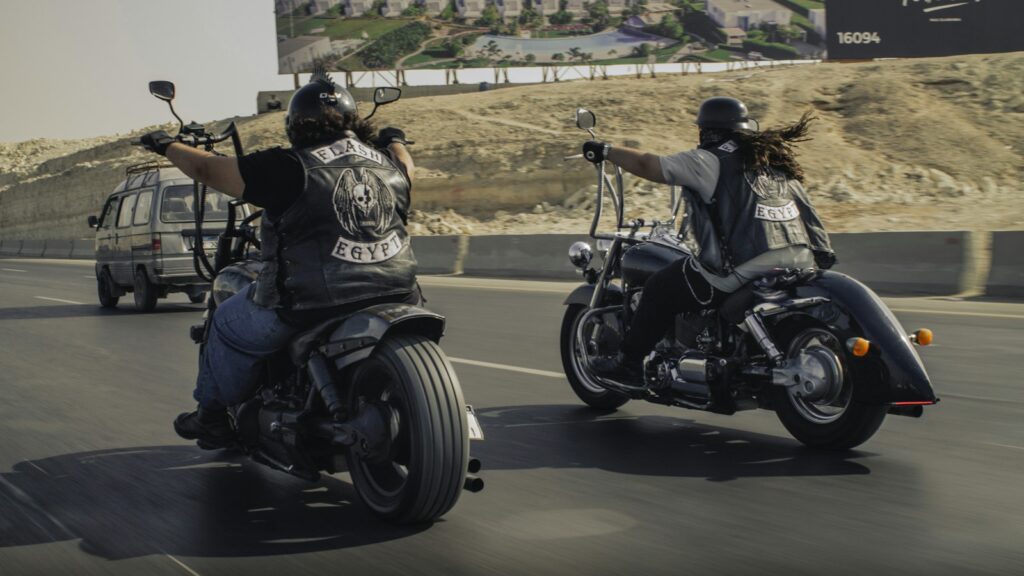
Many clubs wear a back patch made of several separate pieces rather than one large patch. The common layout is:
- Top rocker: a curved banner across the shoulders, usually carrying the club name.
- Centre patch: the club emblem or logo in the middle of the back.
- Bottom rocker: a curved banner below the centre patch, traditionally showing a location such as a city, region or state.
- Small side patch: often reading “MC” and placed beside the centre patch.
A set made up of all of these pieces is often called a three-piece patch. Clubs that wear only a centre patch, or a centre patch and one rocker, use one-piece and two-piece layouts.
Front patches are worn on the chest of the vest. These commonly include a smaller version of the club name or logo, a chapter name, and tabs for the member’s name or club role.
Understand the conventions before you design
In the motorcycle club world, patch layout is not just a design choice. Some layouts, especially the three-piece back patch with a territorial bottom rocker, are associated with established clubs, and wearing them in an area where other clubs operate can be taken as a claim to that territory.
Conventions differ by country, region and club, and they change over time, so there is no single rule book. Before finalising a design, a new club will typically:
- Find out which clubs are active in its area and how they expect new clubs to approach them.
- Check whether any local coalition or council of clubs has expectations about new patches.
- Make sure its name, colours and emblem are not close to another club’s.
- Consider whether “MC” is the right label, or whether “riding club”, “motorcycle association” or no label at all better describes the group.
Many riding groups, charity rides and brand-owner clubs choose a one-piece back patch for exactly these reasons. We make the patch you order, but the decision on layout and wording sits with your club, so settle it first.
Choosing materials for vests and jackets
Embroidered patches
Embroidery is the traditional choice and the most common one for club colours. It is durable, it suits bold emblems and lettering, and it looks right on leather and denim. Most back patches are made with a fully stitched background, which hides the base fabric and gives the patch a dense, solid feel. Our embroidery coverage guide explains the difference between 50, 75 and 100 percent coverage. Start with our custom embroidered patches page.
Woven patches
If your emblem has fine linework or small text, woven patches hold more detail and lie flatter. They are often used for smaller front patches and name tabs.
Leather patches
Debossed or engraved leather patches suit chest patches, event patches and riding-group merchandise. They are less common for a full back set but match a leather vest well.
Sizing a back patch
The back of a vest is the largest area you will work with, but it is not unlimited. Measure the actual vests your members wear, across the shoulders and down the back, and allow space between the rockers and the centre patch. A design that fills a large adult vest will crowd a smaller one.
Rockers should follow a consistent curve so the top and bottom pieces frame the centre patch evenly. Keep lettering bold and large enough to read from a distance on the road. Our custom patch size guide covers typical sizes for chest and back placements.
Borders and edges
Rockers and most centre patches are finished with a merrowed edge, the thick wrapped border found on traditional patches. It is strong and resists fraying, which matters on a patch exposed to wind and weather. Emblems with intricate outlines may need a laser-cut or hot-cut edge instead. Our guide to merrowed vs laser-cut borders compares them.
Get a quote for your club patches
Upload your emblem and rocker wording on our custom patch quote form. List each piece separately, with its size, so we can quote the set accurately.
Attaching patches to leather and denim
Club patches should be sewn on. Iron-on adhesive does not bond properly to leather, and heat can damage it. On a denim vest, iron-on can hold a patch in position while it is stitched, but stitching is what keeps it there.
- Use strong thread suited to leather or heavy fabric.
- Stitch close to the edge, through the merrowed border, all the way round.
- Lay out all the pieces of a back set and measure before you sew, so the rockers sit level and centred.
- A leather repair or saddlery shop can attach patches if you would rather not do it yourself.
For more detail on each method, see types of patch backings and how to attach them.
Design tips for club patches
- Keep the emblem strong and simple. It will be seen from behind a moving bike. A clear silhouette reads better than fine detail.
- Limit the colours. Many clubs use two or three colours across the whole set, which also keeps the pieces consistent.
- Match colours across pieces. Order rockers and centre patch together so the thread colours are identical.
- Use original artwork. Your emblem should be your own design, not adapted from another club’s patch or a copyrighted image.
- Plan for chapters. If the club may grow into several chapters, design the bottom rocker or chapter tab so new locations can be added without changing the rest.
Our guide on how to prepare your logo for custom patches covers file types and simplification in more detail.
Ordering for members
Club patches are usually controlled. Many clubs order a set number for full members and keep track of who holds them. When you order:
- Count members, prospects or probationary members (if they wear different patches) and spares.
- Order front patches, name tabs and back pieces together where possible so colours match.
- Keep the approved proof on file so later reorders are identical.
The ordering process, from artwork to proof approval, is laid out in how to order custom patches.
Frequently asked questions
What is a three-piece motorcycle club patch?
A back patch made of a top rocker, a centre emblem and a bottom rocker, usually with a small “MC” patch. It is associated with established clubs, so check local conventions before using it.
What material is best for motorcycle club patches?
Embroidered patches with a fully stitched background are the most common. Woven patches suit detailed front patches and name tabs.
Can I iron a patch onto a leather vest?
No. Iron-on adhesive does not bond to leather and the heat can damage it. Leather vests need sewn patches.
Can you make rockers and the centre patch as one order?
Yes. Ordering the whole set together keeps the colours and finish consistent across every piece.